Rahul Gandhi has every right to criticise the Union government for its policies, expose failures, and hold those in power accountable.
But when opposition to Modi leads him to endorse foreign statements that belittle India, while he repeatedly attacks constitutional institutions when their decisions are inconvenient for him, a fundamental question arises:
Where does opposition to Narendra Modi end, and responsibility towards India begin?
Consider the recent controversy involving the Supreme Court.
The Kerala wing of Congress, through its official social-media account, demanded the resignation of the Supreme Court Chief Justice and threatened him, “We will find your replacement.”
Even though it was deleted due to wide criticism, the political culture behind such a statement deserves serious scrutiny.
Is threatening to replace the Chief Justice because his observations do not suit your politics an expression of respect for the Constitution?
The same principle applies to the Election Commission.
Question the Election Commission through the procedure established by law. Identify errors in electoral rolls. Demand corrections. Approach the courts. Produce evidence. Every political party and every citizen has those options and rights.
But evidence must receive the same importance as accusations made from political platforms.
Disagreeing with an institution is one thing. Attempting to destroy public confidence in the institutions themselves whenever their decisions are inconvenient is another.
Holding up the Constitution must go hand in hand with respecting the institutions and procedures established by that Constitution.
The same concern arises when Rahul Gandhi responds to statements from abroad.
On July 31, 2025, when US President Donald Trump disparaged India as a “dead economy,” Rahul Gandhi publicly agreed, saying he was glad Trump had stated a fact.
Interestingly, even Congress leaders Shashi Tharoor and Rajiv Shukla took a different position and highlighted the strength of India’s economy, rejecting Rahul Gandhi’s support for Trump.
Criticise Modi’s economic policies as strongly as you wish. But is endorsing a foreign president’s description of the collective efforts of 1.4 billion Indians as a “dead economy,” merely because it helps you attack Modi, responsible opposition politics?
Now consider Elon Musk and Starlink.
Musk has criticised the delays in launching Starlink’s commercial services in India, alleging that powerful business interests are blocking competition. Rahul Gandhi joined the controversy by echoing Musk’s criticism of Indian businessman Mukesh Ambani.
But look at the Congress party’s changing position on Starlink.
In March 2025, senior Congress leaders Jairam Ramesh and Supriya Shrinate strongly criticised the Modi government over SpaceX’s agreements in India. They raised serious concerns about digital sovereignty, national security, regulatory approvals and fair competition for Indian telecom companies.
However, when Elon Musk later criticised the situation, Rahul Gandhi appeared to support his allegations against Ambani.
What changed? Were the earlier security concerns resolved, or did the political position change because Musk’s criticism could now be used against Modi?
This apparent contradiction raises questions about the consistency of Congress’s position on Starlink.
After all, Musk is a businessman pursuing his commercial interests.
Satellite telecommunications involve sensitive matters such as national security, data protection, lawful interception and strategic infrastructure. Starlink has received initial authorisations but must still meet security and regulatory requirements before starting commercial operations in India.
Foreign investment deserves fair treatment, and competition must be protected. But national security cannot be compromised for commercial convenience.
Should India compromise its national security simply to accommodate the impatience of a foreign billionaire?
There was another controversy in September 2024 when Rahul Gandhi met a group of American lawmakers that included Ilhan Omar. Omar had previously visited Pakistan-occupied Kashmir, prompting strong objections from India.
Meeting a foreign lawmaker does not automatically mean accepting that person’s views. But when an Indian opposition leader engages with foreign figures whose positions conflict with India’s established position on sovereignty, he carries an additional responsibility to make India’s position unmistakably clear.
Because India’s sovereignty is neither a BJP issue nor a Congress issue. It is an Indian issue.
And Rahul Gandhi need not look far to understand that distinction.
In 1994, Congress Prime Minister P. V. Narasimha Rao faced a serious diplomatic challenge when Pakistan attempted to secure international condemnation of India over Kashmir at the UN Commission on Human Rights in Geneva.
What did Rao do?
He entrusted Atal Bihari Vajpayee, one of the country’s most prominent opposition leaders, with a leading role in India’s delegation to Geneva.
And what did Vajpayee do?
He did not say, “Narasimha Rao is my political opponent, so anything that embarrasses his government benefits me.”
He stood with his country.
Congress and BJP were political opponents at home. But when India’s interests were challenged internationally, Rao trusted Vajpayee, and Vajpayee defended India.
Pakistan ultimately withdrew its proposed resolution after failing to secure sufficient international support.
That episode contains a lesson that remains relevant today:
Oppose the government. Never confuse that with opposing India’s interests.
That is precisely why the genuine question arises:
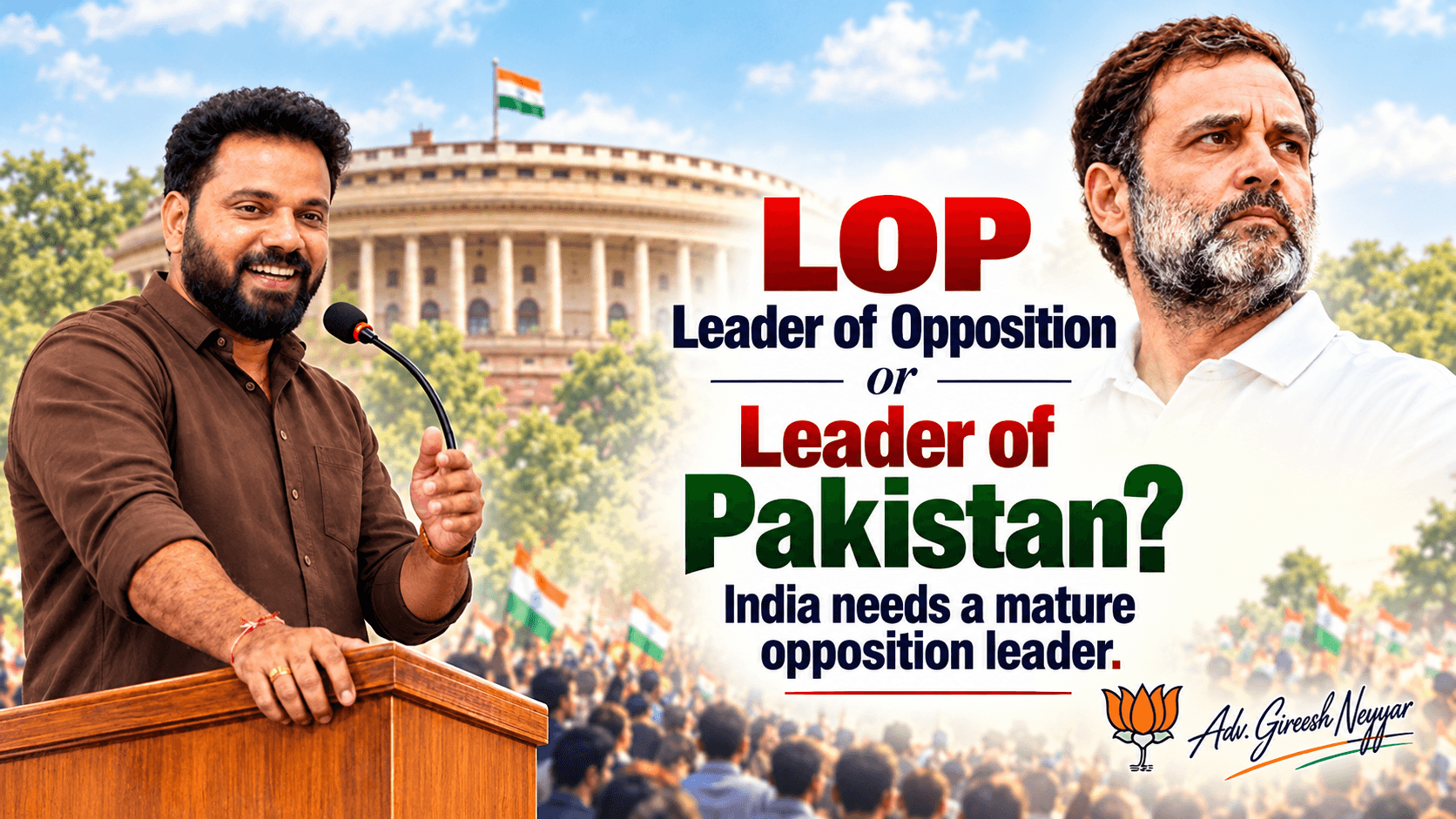
Is Rahul Gandhi the “Leader of Opposition” or the “Leader of Pakistan”?
When Rahul Gandhi questions the government, is the objective to correct government failures, or does the attack end up weakening public confidence in India’s institutions?
When a foreign leader attacks India, does Rahul first examine India’s interests, or first calculate how useful that statement is against Narendra Modi and the BJP?
When foreign political figures or businessmen criticise India, should an Indian opposition leader merely amplify them, or scrutinise their interests as rigorously as he scrutinises his own government?
Pakistan, Bangladesh, America, or any other country will pursue its own national interests. Why should we expect them to pursue ours?
That responsibility belongs to Indians.
Rahul Gandhi should remember the Vajpayee example.
Atalji showed that you can oppose the Prime Minister without opposing India. You can fight a government politically and still stand shoulder to shoulder with that government when the nation’s interests are at stake.
That is political maturity.
That is responsible opposition.
India needs an opposition leader capable of questioning the government with evidence, defending citizens’ rights, correcting mistakes, and respecting constitutional institutions.
But above everything else, India deserves a mature Leader of the Opposition who understands one simple principle:
Modi is not India. BJP is not India. Congress is not India, just as your party once raised the slogan, “Indira is India.”
As Atal Ji said: Governments will come and go, parties will be formed and broken, but this country must remain, the democracy of this country must remain immortal.”
As the Leader of the Opposition, or at least as a citizen of India, you should remember that India must always come first. 🇮🇳
#indiafirst #mistakesofrahulgandhi #leaderofoppositionfails #RajeevChandrasekhar #NitinNabin #AmitShah
Agree with Gireesh's perspective?
Join a community of citizens working towards a better Kerala through education, innovation, and public service.
Join the Movement